
Essay grading is one of the most exhausting parts of teaching. A single class of 30 students can generate anywhere from 15 to 30 hours of grading work per week.
Multiply that across a full semester, and it’s easy to see why teacher burnout rates are at an all-time high.
AI essay grading tools are changing that equation. These platforms use artificial intelligence to evaluate student writing against rubrics, generate structured feedback, detect plagiarism, and surface performance insights — all in minutes instead of days.
But not every tool is built the same way, and teachers deserve an honest breakdown before committing to one. Let ‘s see more!

6 Best AI Essay Grading Tools
We’ve prepared a list that covers the six best AI essay grading tools available right now, rated based on actual classroom utility, grading accuracy, standards alignment, and time savings.
Whether you’re a K-12 teacher managing 150 students or an online instructor running multiple sections, there’s a tool here that fits your workflow.
– Blended Learning: How your school can combine online and offline teaching
1. EssayGrader.ai
When teachers talk about AI essay grading tools that were actually designed for them — this is one that consistently comes up.
Built by teachers for teachers, EssayGrader is the most fully featured rubric-based AI essay grader available today.
It’s main features are:
- Time Savings: Can reduce grading time by up to 80%.
- Standards-Aligned Grading Across Major Frameworks: Supports CCSS, AP, IB, STAAR, CAASPP, and a wide range of other state and national frameworks.
- Custom Rubrics and a Library: Teachers can upload existing rubrics, build new ones from scratch, or choose from a library of over 500 pre-built, standards-aligned rubric templates.
- Actionable Student Feedback: Generate structured feedback on grammar, content organization, structural coherence, and writing style.
- Bulk Upload and LMS Integrations: Teachers can upload entire class sets at once via Google Classroom, Canvas, Google Drive, or OneDrive.
- Plagiarism Detection: AI content detection and plagiarism detection built into the grading workflow.
- Privacy and Compliance Built In: Meets FERPA, COPPA, SOPPA, and PIPEDA compliance requirements. Data is protected with TLS and AES-256 encryption, and the platform maintains a strict no-training-on-student-data policy.
Best for: Teachers at any level who want a rubric-based grading tool with standards alignment.
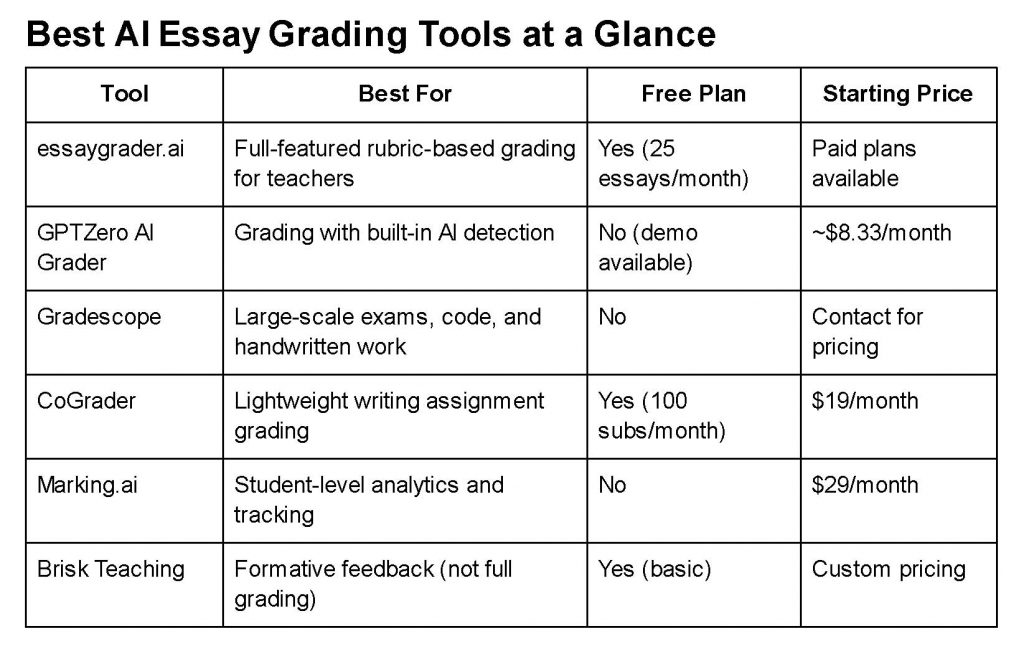
Free plan: Yes — 50 essays per month at no cost.
– Can AI Writing Be Flagged as Plagiarism? What You Should Know
2. GPTZero AI Grader
GPTZero is best known as an AI content detector, but the platform also offers an essay grading tool that integrates detection directly into the assessment workflow.
Teachers who consider AI detection to be a non-negotiable part of their grading process will find this particularly appealing.
The grading flow involves selecting or building a rubric, uploading student submissions, and running a calibration step where the teacher grades three to five essays manually so the AI can learn their grading style.
From there, GPTZero grades remaining submissions against that calibrated baseline.
The platform integrates with Google Classroom, Canvas, Blackboard, and Moodle, so teachers don’t need to download and re-upload files.
Completed grades can be exported as PDF, Word, or Google Docs documents.
One notable limitation is the absence of a free plan — there’s a demo available, but ongoing use requires a paid subscription starting at around $8.33 per month, with district pricing available for institutional deployment.
Best for: Teachers who prioritize AI writing detection as a core part of grading and want a single tool that handles both tasks.
Free plan: No (demo only).
– How to use ChatGPT to generate quality content
3. Gradescope
Gradescope was built for higher education environments where instructors deal with large lecture sections, multi-part exams, handwritten work, code submissions, and problem sets.
The platform uses AI to group similar student responses together, making it possible to grade an entire class’s answers to a question simultaneously.
Once you apply a score and feedback to one representative example, Gradescope applies the same evaluation to all similar responses — a significant time saver for standardized test items.
Gradescope doesn’t offer a standalone free plan, and pricing is structured around institutional contracts rather than per-teacher subscriptions.
Create your online course with Coursify.me
Everything you need to create, sell and deliver your courses, in one platform.
Get startedIt’s a strong choice for college instructors and university departments, but it’s likely overkill for K-12 teachers grading paragraph-length responses.
Best for: Higher education instructors managing large classes with complex, multi-format assessments.
Free plan: No (institutional trial available for one term).
– How Online Programs Are Training People for In-Demand Jobs
4. CoGrader
CoGrader is a straightforward AI grading tool designed specifically for written assignments.
It doesn’t try to do everything — it handles essay grading, generates feedback, and produces a summary of class performance.
That simplicity is part of its appeal for teachers who want a quick solution without a steep learning curve.
The platform supports custom rubric uploads and produces feedback comments students can act on.
There’s a free plan that allows up to 100 submissions per month. Paid plans start at $19 per month.
CoGrader’s main limitation is scope — it doesn’t include AI detection or plagiarism checking, and it lacks the deeper analytics available in more comprehensive platforms.
Best for: Teachers who need basic, rubric-based AI grading without added complexity.
Free plan: Yes — up to 100 submissions per month.
5. Marking.ai
Marking.ai takes a data-forward approach to AI essay grading.
The platform grades essays and produces feedback, but where it differentiates itself is in the depth of its student-level analytics.
Teachers can track individual writing proficiency scores over time, identify specific skill gaps at the student level, and monitor progress across assignments.
For teachers who rely on data to inform instruction — particularly in schools with benchmark reporting requirements — this level of insight is genuinely useful.
The platform doesn’t offer a free plan, and pricing starts at $29 per month.
The tradeoff is that Marking.ai lacks the LMS integrations and bulk upload capabilities.
Best for: Teachers in data-driven instructional environments who want granular progress tracking alongside AI grading.
Free plan: No.
6. Brisk Teaching
Brisk Teaching occupies a slightly different category from the other tools on this list.
It functions primarily as a Chrome extension that overlays on top of Google Docs and Google Classroom, offering AI-generated formative feedback.
Teachers using Brisk can quickly generate feedback comments on student drafts, suggest revision areas, and identify common issues across a class — but they’re not getting a scored, exportable grade report.
Brisk is designed to support the feedback process, not replace the grading decision itself.
There is a free plan with basic feedback styles, and pricing for school and district-level access is custom.
For teachers who want to add AI assistance to the feedback stage of their workflow without fully automating grading, Brisk is a reasonable choice.
Best for: Teachers who want AI-assisted formative feedback rather than complete automated grading.
Free plan: Yes (basic feedback styles only).
– How to Evaluate EdTech Tools for Real Classroom Impact
How to Choose the Right AI Essay Grading Tool

With several capable tools in this space, the right choice depends on a few key factors:
- Volume matters most. If you’re grading more than 60 essays per week, you need a tool with true bulk upload capability and LMS integration. The time savings only materialize at scale when the upload and export process is also streamlined.
- AI detection has become a baseline expectation. With generative AI tools freely available to students, grading platforms that don’t include detection leave teachers with an incomplete picture of their students’ work.
- Student feedback quality determines actual value. A score without feedback doesn’t help students improve. The best AI essay grading tools produce comments that are specific enough to guide revision.
- Privacy compliance is a hard requirement. Any tool processing student data needs to meet FERPA requirements at minimum. In schools serving minors, COPPA compliance is equally important.
Any of these tools will save you time, choose wisely based on your specific needs.
EssayGrader offers a combination of rubric flexibility, bulk grading, standards alignment, built-in AI and plagiarism detection, detailed student feedback, and strong privacy compliance.
GPTZero is the best alternative for teachers who want detection-first grading, while Gradescope fills a specific niche in higher education.
CoGrader and Marking.ai serve teachers with more targeted needs, and Brisk is worth considering for those who want feedback support rather than full automation.
All are great choices for online course teachers, having integration with a LMS being a plus.
Coursify.me is an eLearning platform that enables integration with existing software of partners. We have an API for obtaining course information and we can develop at no cost any other API needed to integrate your company’s software with our platform.
– What is an API and how important is it to your online business?
Complete LMS, Coursify.me it’s the perfect solution for anyone who wants to create, sell and promote your courses on the internet.
– What is a Learning Management System
To find out more, visit Coursify.me test the platform and understand why we are the best option for your business.
If you have any questions, just